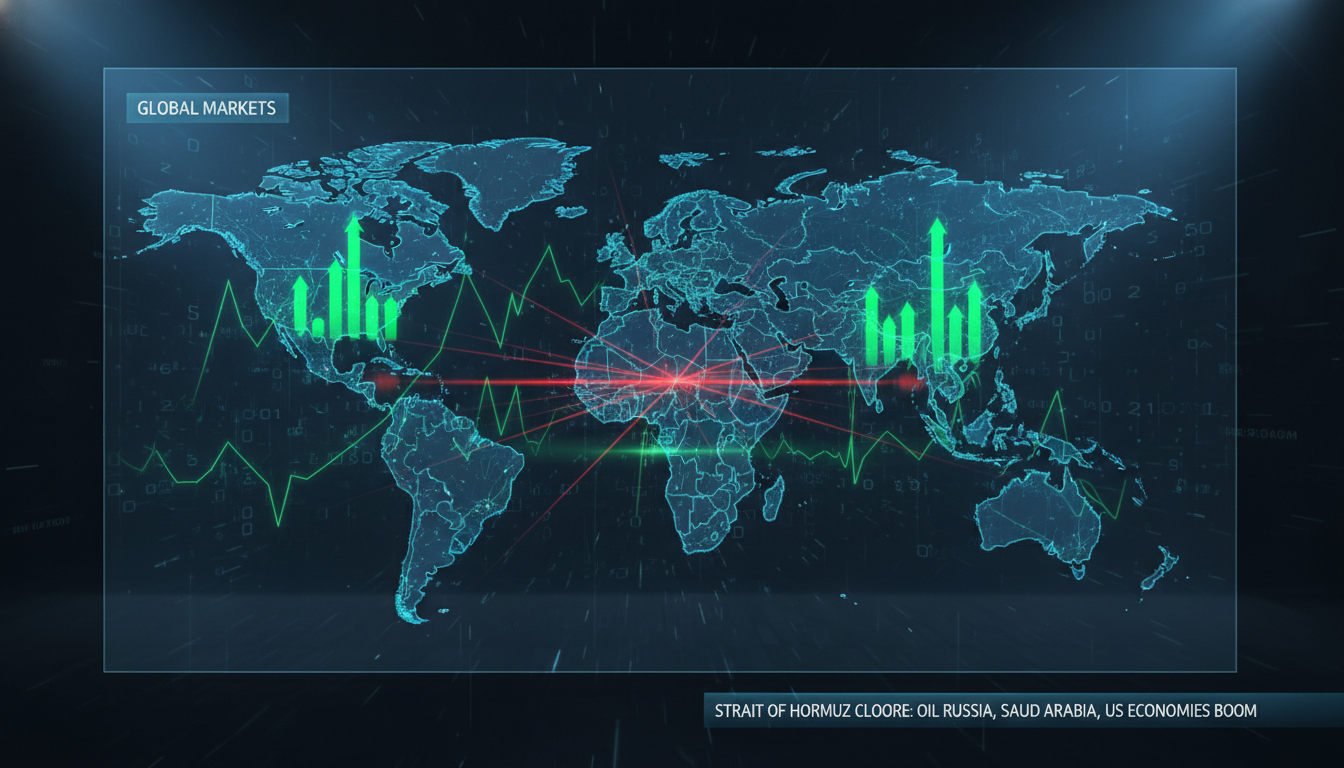
Who’s Winning the War? The Countries Profiting From the Iran Oil Shock
As the Strait of Hormuz closure knocks 14 million barrels per day off the market, a new hierarchy of energy superpowers is emerging from the chaos.
Christian Rosenblum
Managing Editor
Key Takeaways
- Russia has seen a 39% surge in state oil revenue despite ongoing sanctions.
- Saudi Aramco recorded a $33.6 billion windfall in Q1 2026 despite transit restrictions.
- The UAE’s departure from OPEC signals a permanent fracture in global oil price management.
- The IEA warns of a critical 'Red Zone' for global stocks by July if the blockade continues.
- High prices are inadvertently accelerating green energy investment in the West.
It has been three months since the Strait of Hormuz effectively became a dead zone for international energy transit, and the global map of winners and losers has never been more starkly defined. Since late February 2026, the 'Iran War' has triggered the largest supply disruption in history, removing 14 million barrels per day (bpd) from the market and sending global crude prices into a tailspin of volatility.
As an investor, looking past the headlines and the geopolitical tragedy is essential to understanding where the capital is flowing. While global consumers are feeling the pinch of $4.50+ per gallon at the pump, a select group of 'war profiteers' and 'new neutrals' are seeing their balance sheets swell with unearned windfalls. Here is the state of play as of late May 2026.
The Primary Beneficiaries: Russia and the 'Old Guard'
The most immediate and perhaps most controversial beneficiary of this crisis is Russia. Despite continued western sanctions, Moscow has effectively become the safety valve for a desperate global market. This month alone, state oil and gas revenue has surged by 39% compared to last year. The IMF has been forced to revise Russia’s growth projections upward as the world’s thirst for non-Middle Eastern oil overrides political posturing.
Meanwhile, Saudi Arabia finds itself in a paradoxical position. While the Hormuz closure restricts its primary export route, Riyadh has leveraged its massive scale and alternative pipeline infrastructure to reap what we at Fox Energy call a 'war windfall.' Saudi Aramco’s Q1 profits surged by roughly $33.6 billion, a 26% increase that highlights the power of holding the world’s spare capacity when everyone else is running dry.
The United States: A Tale of Two Economies
For the U.S., the Iran War is a double-edged sword. Domestically, the Trump administration is facing a polling nightmare as inflation remains stubborn. However, on the corporate and macro levels, the U.S. remains a dominant energy exporter. U.S. majors like ExxonMobil are recording billions in unearned profits. This insulation from the worst of the shock—compared to Europe or Asia—has kept the U.S. economy afloat even as demand destruction begins to take hold in other sectors.
The 'New Neutrals': Oman and the UAE
Perhaps the most fascinating shift is the emergence of 'strategic neutrals' in the Gulf. Oman is currently in high-level talks with Tehran to charge transit fees for the few vessels still navigating the peripheral waters, effectively monetizing the blockade itself.
Then there is the UAE. In a move that shocked the markets earlier this quarter, the UAE quit OPEC to pursue independent production targets. By decoupling from the cartel’s restrictions, Abu Dhabi is positioning itself to capture market share that Saudi Arabia and Iran cannot currently touch. This 'every nation for itself' mentality suggests that the era of coordinated OPEC+ price management is essentially over.
The IEA 'Red Zone' and What Comes Next
The International Energy Agency (IEA), led by Fatih Birol, has issued a dire warning: if the Strait of Hormuz does not reopen unconditionally by July, global oil stocks will hit the 'red zone.' This is the point where strategic reserves are exhausted, and we face genuine physical shortages.
For accredited investors, the play isn't just about who is pumping more oil today. It’s about the Green Acceleration. Paradoxically, these high oil prices are acting as a massive, unintended carbon tax. We are seeing record-breaking capital flows into EV infrastructure and public transit in the UK and US as the 'forced destruction' of oil demand makes fossil fuels economically untenable for the average consumer.
Investor Strategy: Trust but Verify
While 'draft peace deals' have caused wild swings in the trading markets over the last 48 hours, I remain skeptical. Iran’s refusal to send enriched uranium abroad remains the primary sticking point. Until that moves, the 'War Profiteers' will continue to see record inflows, and the energy map will remain fractured.
Stay tuned to Fox Energy for real-time updates on [Energy Sector Trends] and our upcoming deep dive into [Oil Price Forecasts] for Q3 2026.
Frequently Asked Questions
Is a peace deal likely to lower prices soon?
While recent rumors have caused market volatility, Iran's refusal to compromise on uranium exports suggests that a full reopening of the Strait of Hormuz is not imminent. Investors should prepare for sustained high prices through Q3 2026.
Why is the UAE leaving OPEC important?
The UAE's exit allows them to produce at capacity without being held back by Saudi-led quotas. It marks the end of unified OPEC+ strategy, creating a 'free-for-all' market environment that favors high-production states.
Christian Rosenblum
Managing Editor